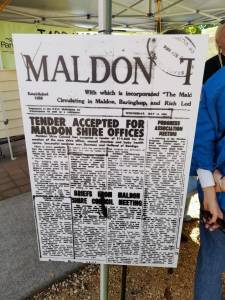
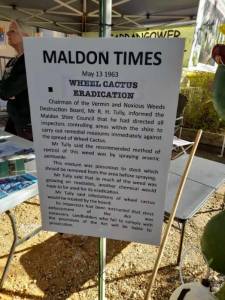
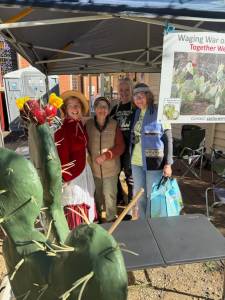
While preparing for the recent “Notable Day Out” at Maldon Market, members of the Tarrangower Cactus Control Group decided to have signs made displaying an old newspaper article from the Maldon Times, dated May 13, 1963. More than sixty years later, the words are a fascinating and sobering reminder that Wheel Cactus has been a serious concern in our district for decades.
The article reported on advice from the Chairman of the Vermin and Noxious Weeds Destruction Board, Mr R. H. Tully, who warned Maldon Shire Council about the spread of Wheel Cactus throughout the area. Inspectors were instructed to begin immediate remedial action and strict enforcement of the legislation was flagged, including possible prosecution for landholders who failed to comply.
At the time, the recommended treatment was spraying with arsenic pentoxide. Even in 1963, authorities recognised the scale of the problem, particularly with infestations spreading along roadsides and throughout the broader landscape.
Reading the article today raises an obvious question: imagine if Wheel Cactus had truly been brought under control back then. How different might our landscape look today if widespread action, persistence and long-term commitment had followed those early warnings?
Unfortunately, that did not occur. Instead, Wheel Cactus continued to spread, embedding itself into farming land, bushland and roadsides. Large infestations became almost impenetrable, reducing agricultural productivity, threatening native vegetation and creating ongoing costs and challenges for landholders.
And yet there is also another important question to consider. What would our region look like now without the efforts of the “Cactus Warriors” over more than twenty years?
The work of local volunteers and landholders has prevented countless new infestations, reduced existing outbreaks and kept pressure on this invasive weed across the Tarrangower district and beyond. It is difficult to measure the full impact of that work because it is hard to measure what doesn’t happen: properties not infested, paddocks kept productive, native vegetation protected and new outbreaks stopped before they spread.
The 1963 article serves as both a historical curiosity and a timely reminder. Wheel Cactus is not a new problem. Previous generations recognised the danger it posed, and today’s landholders continue to deal with the consequences of how difficult containment is once invasive species become established.
It also reinforces the importance of continuing the work. Persistence matters. Community cooperation matters. Government assistance matters. Early intervention matters.
And perhaps, sixty years from now, future generations will look back and recognise that the efforts being made today were what finally turned the tide.